Sunday, September 30, 2012

Q.) What are vegans allowed to eat? A.) Anything.

There is a particular thing that non-vegans sometimes say that drives me crazy. I know it's innocently meant, but it just pushes my buttons. It comes up at work fairly frequently, and it goes like this:

"There's [insert name of food here] in the kitchen. Are you allowed to eat that?"

Allowed? Allowed by whom?

I'll have patience with it the first time, maybe even the second. Though I always answer the exact same way, the answer comes out a little bit snippier each time I have to repeat it to the same individual. Because it seems no matter how many times I explain it, the question keeps coming back. And the answer is this:

"I am allowed to eat anything I want. I choose not to eat anything that contains animal products."

There is no Dr. John Q. Veganizer, M.D. writing a book to specify what I'm 'allowed' to eat. Saying something is 'allowed' implies that there are consequences if one does that which isn't allowed. There are no personal consequences here. There cannot be, because I make this choice not for reasons of my personal health, nor from societal pressure to conform in my personal appearance, but for the benefit of other living creatures.

It's important to understand that veganism is not a diet. People who choose to stop eating animals for health or appearance are following a plant-based diet - strictly speaking, they are not vegans. The word vegan applies to those whose decisions are based on ethics and go beyond just food, including also clothing, toiletries, medicines, and entertainment that exploits animals. Veganism comes from a totally different root than following a diet.The act of dieting is rooted in a concern for self. Certainly that can be a good and right concern - I'm not saying there's anything necessarily wrong with it. The point I'm making is that veganism is rooted in the concern for others, and no one can 'allow' you to put others before yourself. That's a choice only you can make, so to say "allowed" becomes subtle downplaying of a person's agency in making this choice.

If someone tells you they're following the South Beach Diet, or Atkins, or even a doctor-recommended meal plan for a certain health condition, asking what they are 'allowed' to eat makes sense to some degree. These diets were essentially thrust upon them, either by a healthcare professional, a personal health concern, or by society, in the form of a belief that they must meet a certain weight standard. They still made the choice to stick that diet, yes, but probably not because they really wanted to do so. Ask anyone who is on a diet for health or weight reasons, and they're pretty likely to tell you they wish they could eat the things they did before. 

No so with vegans. (Or at least, not so with those of us whose convictions are firm and habits are set - I admit, it can be tough when you're making the transition from the old way of doing things.) Veganism is a conscious decision based on ethics; the underlying motivation is different. I want to be a vegan, and I want to be a vegan for life. I have no wish to return to the way I ate before.

When it comes down to it, veganism is simply not restrictive. You do not miss doing something that you don't want to do. I made a choice not to eat animals, and that choice brings me peace and contentment, not a sense of deprivation. To ask me what I'm "allowed" to eat demeans that choice.

So for the record, non-vegan friends, the appropriate question is this:

"Is that something you'll eat?"

Wednesday, September 19, 2012

A vocabulary lesson for the Fish & Wildlife Service

ref·uge/ˈrefˌyo͞oj/

Noun:
  1. A condition of being safe or sheltered from pursuit, danger, or trouble.
  2. Something providing such shelter.
Synonyms:shelter - asylum - sanctuary - haven - harbor - harbour

Right now, officials at the Fish and Wildlife Service (FWS) are contemplating allowing the hunting of alligators for sport inside the Arthur R. Marshall Loxahatchee National Wildlife Refuge. This refuge is the northernmost remnant of the Everglades, a delicate and threatened ecosystem in which alligators play an important role.
Alligators are an important part of the Everglades ecosystem and are considered a keystone species of the park. The nesting activity of female alligators is important for the creation of peat. Several turtle species, such as the Florida red-bellied turtle (Chrysemys nelsoni), incubate their eggs inside both active and old/abandoned alligator nests. Water remains in alligator holes throughout the year except during severe drought conditions. As the dry season approaches and water dries up from other areas within the Everglades, the retained water causes alligator holes to become a refuge for a variety of wildlife. [Source: National Park Service]
The National Park Service also points out that this is a species that was previously hunted to the threat of extinction.

Dwindling populations of alligators were the result of hunting and loss of habitat, and the American alligator was listed as an endangered species in 1967 under a law that preceded the Endangered Species Act of 1973. The number of alligators began to rebound when alligator farms opened and hunting was outlawed, easing the pressure on wild populations. However, even after hunting was prohibited in Florida, illegal poaching continued into the 1970s because the belly skin of alligators produces high-quality leather. Were it not for additional changes in the law controlling the movement of alligator hides, extinction may have been possible. Populations have since improved considerably, and alligators were removed from the list of endangered species in 1987 and are continuing to thrive in Florida today.

While it's true that alligators populations are currently stable, today they also face a threat from the invasive Burmese python. While the alligator was once the apex predator in the Everglades, now they have competition for food supply. Also, the Burmese python has been known to eat juvenile gators. The long-term impact this threat will have on alligator populations is yet unknown, but considering the loss of prey, the outlook isn't positive.

All of these are good reasons for the FWS to say no to alligator hunting on the refuge. But perhaps a better reason is in the name of the park itself - the Loxahatchee National Wildlife Refuge.

The concept of a refuge is an ancient one. Cities of refuge for humans are documented as early as the 8th century B.C.E. The first known animal refuge was established in the 3rd century B.C.E. In the United States, the tradition of wildlife refuges goes back nearly 150 years, or more than half of our history as a nation. We established these park lands to protect wildlife and plant life from the constant threat that we ourselves pose through encroachment on their habitat. But more than that, these areas of sanctuary are a reflection of our desire to preserve and enjoy the natural world in a pristine state..

And at the Loxahatchee NWR, we do just that. While fishing and limited waterfowl hunting is already allowed on the site, FWS says that the majority of the 300,000 visitors to the site each year are "non-consumptive users" -- those of us who are there to hike, bike, canoe, kayak, trail walk, or photograph.

National Wildlife Refuges are the only public lands specifically set aside for wildlife. Allowing any hunting on site is against the spirit and purpose of these lands. However, alligator hunting is particularly barbaric. The sport hunting proposal under consideration describes the allowable means for capture:


Alligators may be taken using hand held snares, harpoons, gigs, snatch hooks, artificial lures, manually operated spears, spear guns, and crossbows . 


Harpoons. Hooks. Spears. Crossbows. These weapons are designed to painfully injure during capture. And an injured alligator does not become docile. No, these powerful creatures will fight their capture, prolonging their pain and suffering until their ultimate death.

Is this the sort of "sport" you want to witness when you're peacefully hiking or boating through the park? Allowing sport hunting of alligators not only robs the alligators of peaceful sanctuary, it robs the hundreds of thousands of us who are "non-consumptive users" of this natural haven too.

I regularly drive 45 minutes to visit Loxahatchee NWR and take solitary walks along the levies. I take my children to the festivities for Everglades Day. The pristine natural beauty of the preserve, the opportunity to observe our native fauna in their natural habitat, the very peace of the place is under threat from this proposal, just as the alligators are. I say NO to the cruelty of alligator sport hunting at Loxahatchee. I say NO to diminishing an animal population that is already under pressure from loss of habitat and invasive species. I say NO to a violation of the very idea of a refuge. I say NO to the violence threatening to intrude on a place of peace.

A public meeting is being held Sept. 20, 2012 to discuss the issue, so action is critical now. [UPDATE: The deadline for comment has been extended to October 21, 2012!] Please sign this petition, Say NO to Killing Alligators on a Wildlife Refuge,  and/or email Rolf Olson, Deputy Project Leader at rolf_olson@fws.gov. (Please mention if you have been to or plan to visit the refuge when you write.)

Please let your voice be heard on this important matter today!


Click here to view an album of my photos from: Arthur R. Marshall Loxahatchee Preserve

Saturday, September 15, 2012

Photos: Leu Botanical Gardens - Orlando, FL

Last month, I had the pleasure of visiting Leu Botanical Gardens. These are a few of my favorite photos.

The tropical section


In the rose garden


In the butterfly garden


Wednesday, September 12, 2012

Help! My kid's gone vegan! - A guide for non-vegan parents of vegan teens

As parents, we spend a lot of time thinking about what our kids eat. It begins from the very day they are born. Over the course of their childhoods, we worry whether they are getting enough nutrition, plan and schedule their meals, and help them develop what we believe to be the best eating habits.

So parents may experience a variety of reactions when their teen suddenly announces a desire to go vegetarian or vegan. You may be confused as to why your child has made this choice, concerned for their health and nutrition, or angry at what might seem like a judgment on the eating habits you’ve taught them or the way you choose to eat yourself. You may feel frustrated at what may seem like yet another teenage rebellion. All of these are normal reactions. But despite these feelings, why should you support your child’s desire to “go veg”?

Today, we spend a good deal of effort teaching our teens that their bodies are their own. We teach them that no one has a right to touch them in a way that makes them uncomfortable; we teach them that real friends don’t pressure use drugs or alcohol. Essentially, we teach them that they have the right to control what happens to their bodies and to say “no” to what they feel is wrong for them. Ask yourself, so long as your child’s dietary choices are healthy and safe, would it not undermine that message to insist they put what foods you choose into their bodies, not what they choose? Isn’t that sending mixed signals?

But, you may ask, is a vegan or vegetarian diet actually safe and healthy? You’ll be relieved to know that according to the Academy of Nutrition & Dietetics - the largest organization of nutrition professionals in the world - a vegetarian or vegan diet is safe and appropriate for people in all stages of life, from infancy to adulthood. In fact, they note that not only are these diets “healthful” and “nutritionally adequate”, they “may provide health benefits in the prevention and treatment of certain diseases.”

Certainly, as they point out, a vegan or vegetarian diet must be “appropriately planned.” But that planning is not so difficult as you may fear. Contrary to what you may have heard, it is easy to get enough protein, as well as most vitamins and minerals, from everyday foods. The Physician’s Committee for Responsible Medicine (PCRM) has terrific advice on planning a healthy vegan or vegetarian diet for children of all developmental stages.

Moreover, today it is easier than ever to be a vegan or vegetarian. Most grocery stores carry vegan staples like almond milk, soy yogurt, or veggie burgers. And many of the foods your teen may already eat - from cornflakes to cookies, from soup to snacks - may be “accidentally vegan.” Most restaurants have vegetarian options on their menus, and many can be made vegan simply by saying “hold the cheese.” Many colleges today are even going vegan-friendly!

So what can you do to support your vegetarian or vegan teen? Here are some important guidelines.
1. Talk to your child about why they’ve made this decision. 
Most kids go veg for reasons of conscience. Frequently, they’ve realized for the first time that the animals they visited at the petting zoo when they were younger are the same kinds of animals that end up on their plates, or have seen videos documenting the conditions in factory farms. While you may not personally have an ethical concern about eating animals, shouldn’t we encourage our children to explore ethical issues as they mature and live by the standards they believe to be right? Each of us surely want to see our children grow into adults with integrity and the courage to stand up for what they believe. 
However, it’s possible that your child might be going veg for the wrong reasons: as a fad diet, to impress someone they have a crush on, or on a whim - without giving nutrition much thought. It’s important that you make sure they’ve thought the decision through, and are ready to take the additional level of responsibility for their own nutritional health that going veg can require. 
2. Come to an agreement on terms. 
Obviously, you’re going to have concerns if a child who has never willingly eaten a vegetable announces they’re going vegan. Let your child know that in order to have your support in this choice, they have to agree to eat a healthy diet - including a variety of fruits, vegetables, grains, beans, and nuts - and to take their vitamins. Do the research together and make sure you both fully understand how a healthy vegetarian or vegan eats. 
Also, depending on your home environment - who does the cooking and shopping, for example - you may need to come to an agreement on how much responsibility your child will have to take for preparation of their own meals. A vegetarian or vegan can often share many of the same dishes with the rest of the family, eating the side dishes that are prepared or taking out a serving of a main dish before meat is added. But come to an agreement about what will happen when the family is eating something that your veg kid won’t eat. Consider school lunches as well, and whether appropriate options are available, or if your child will have to pack a lunch. 
3. Monitor your child’s health. 
During routine physicals, remind the pediatrician of your child’s dietary choices. When doing blood tests, the doctor may choose to check your child’s levels of certain vitamins or minerals that may be of greater concern in vegetarian or vegan people, such as iron, and vitamins D and B12. For most people, a daily multivitamin combined with a healthy diet including fortified foods (such as cereals, breads, and non-dairy milks) is enough to meet their needs for these vitamins and minerals, but it’s good to check and make certain your child is getting enough of them. 
Between physicals, make sure that your child is eating sufficient calories. Vegetarian and especially vegan foods tend to be lower in calories, and some people may need to increase the volume of food they eat in order to take in enough. If your child lacks energy, seems fatigued, or loses weight uncharacteristically, consult with their pediatrician, but they may simply not be eating enough. 
If your child is having difficulty meeting their nutritional requirements, most insurance companies will pay for a consultation with a registered dietician. These nutrition experts will be able to help your teen come up with a plan for meeting their needs. 
4. Refrain from teasing. 
You’ll be hard pressed to find a vegetarian or vegan adult who doesn’t occasionally get frustrated with teasing from well-meaning family and friends about their food choices. But teens may be less equipped to handle the razzing. Whether it’s trying to tempt them to eat foods they no longer eat, or silly jokes about the poor broccoli they’re “killing,” your kids are likely to receive some teasing from their schoolmates, peers, and even siblings for being different. Make home a supportive environment where they can feel comfortable with their choices. (It may help to have siblings involved in your discussions from the beginning, so they understand why their brother or sister is making this change and what it will involve.) 
5. Be an advocate for your child. 
There are occasions that can be difficult for a vegetarian or vegan child to navigate alone: parties, field trips, family holidays, and other everyday events where their food choices may become an issue. Depending on your child’s personality, they may have a hard time speaking up or planning ahead to make sure they will be able to comfortably enjoy events where food is involved. Encourage your child to ascertain ahead of time whether veg-friendly food will be available, and to plan to bring their own if it is not.
Raising a happy, healthy vegan teen does take a little bit of adjustment, not just on your child’s part but on yours as well. But the benefits are many: your child will likely become more open to trying new foods, be more conscious of their health and nutrition, become more sensitive to social and environmental issues, and may avoid many diet-related illnesses later in life. Plus they’ll develop the strength of character that comes from following their conscience, and the confidence that comes from knowing they have the support of loving parents. And isn’t that what we all want our children to have?

More Online Resources for Parents:

The Vegetarian Resource Group
Vegetarian Kids, Teens, and Family
http://www.vrg.org/family/kidsindex.htm

Boston Vegetarian Society
Resources for Raising Vegetarian & Vegan Children
http://www.bostonveg.org/vegan_kids.html

Tuesday, September 11, 2012

Feeding the hungry while caring for the animals.

There was a conversation recently in the Livejournal community Veganpeople that I found truly disturbing and indicative of an ongoing problem in a segment of the vegan community -- a lack of respect and compassion for non-vegan people. (Please understand, I do not suggest that this is characteristic of the vegan community as a whole, but I'm referring to the folks who give the rest of us a bad name.)

The question was raised whether it was ethical for a vegan to give money to a homeless person, knowing they may spend it to buy a hamburger. This is a valid question, of course, but it unleashed a good deal of privilege, stigmatic language, and apathy. I'm used to that in conversations about the homeless, but I suppose I just hoped that as a compassion-focused group, our vegan community would rise above.

Homeless kids, facing away to respect
their privacy, showing off the gifts they
received through The Humble Stitch Project
while the weather was still warm.
Depending on how you came to be reading this blog, you may know that I'm the founder of The Humble Stitch Project. In two winters, we've managed to make and distribute nearly 1,000 cold weather clothing items (handmade scarves, hats, and gloves) to the homeless of South Florida. We've accomplished this by relying on the compassion of individuals all over the world who have donated their time, their handiwork, and their supplies to make this happen.

The impetus for starting The Humble Stitch was to help restore the dignity of our homeless neighbors. We could have done a drive to collect used clothing, or a fundraiser for the local homeless outreach programs. Why handmade? Because a handmade item does more than keep the recipient warm; it shows them that someone cares. Someone chose to give them a gift, not just charity. (With a gift, the giver and the recipient can be equals. With charity, one is held above the other.) By giving a gift, by treating them as equals, we grant them the dignity that all living beings deserve.

Similarly, by allowing people to make their own decisions we treat them as equals. By taking that decision away from them, we diminish them. So while The Humble Stitch website FAQs state a preference for vegan fibers, we won't reject any item that's received. Why? It's not our right to make that decision for someone else. Who am I to decide for someone else whether they would rather wear wool or risk exposure?

The same principle applies to food. It is not for me to dictate to any person what they can or cannot eat, as though they were my child. It's patronizing and demeaning to do so, and simply foolish to suppose that doing so when you have someone over a barrel has any significant impact. As I pointed out in the Livejournal discussion, even if I were to accompany the person to a nearby store and purchase them something vegan to eat, what is stopping the store owner from using the profits from my purchase to restock the beef jerky? And what's to stop the person in need from going to buy that burger with the next dollar he or she receives? Focusing on that one meal is "straining out the gnat, but gulping down the camel." As advocates, we have bigger targets for which to aim. We need to worry about the food system that feeds a cow unnatural amounts of grain, or force-feeds fowl until their livers are about to burst, but starves the hungry and thirsty children of the planet.

But, my vegan friends may ask, how do I justify giving money that I know may contribute to animal exploitation? Unless your landlord is a vegan, and your dentist, and your hairstylist, you're unfortunately already in that situation. The money that you pay them feeds their families, does it not? Last year, a wise vegan friend said to me, in reference to giving money to the homeless, "Whether I give it to them is between me and God; what they do with it once I do is between them and God." Just as we have no right to make choices for others, we are not responsible for the choices they make.

Certainly no one is obligated to give money to every person in need who asks. But if you choose to do so, do so from compassion. Give it as a gift, not just charity. Afford the person the dignity of making their own decisions, and focus your energy where it can do real good - convincing others of the vital reasons to re-evaluate their food choices.

The change that vegan advocates wish to see starts in the mouths of men and women - not just with what we eat, but with what we say. This is why it's vitally important that we demonstrate compassion, not just for animals, not just for the disadvantaged, but for every person we speak to about veganism. If others feel diminished by our discourse, they will never benefit from it. We must recognize their right to make this decision for themselves, while we help them to see what the best decision is.

Friday, September 7, 2012

Wherein I Pledge to Elevate the Discourse


I have a formal policy of treating others with respect. I address it in the notes on my About Me post.I talk at length about in my post Kasey's Rules for World Peace. But now I'm taking it one step further and asking you to sign on to this policy, and to spread the idea to others.

Like me, are you tired of all the name-calling? Whether the topic is politics, religion, animal rights, or which side of the bread you should butter, what does it accomplish to call the other side of an argument "jerks", "morons", or worse? You're not bringing anyone around to your point of view by insulting them. You're only making the disagreement more acrimonious.

Our goals in any disagreement should be to convey our beliefs and learn the other person's, then to use reason, logic, education and/or empathy to persuade. When we disrespect the person on the other side of the divide, we alienate them and lose any chance we may have had to ever reach accord.

So here it is:

I pledge to elevate the discourse when I enter a debate. I pledge to show understanding and tolerance of different points of view, and not make assumptions about people's intelligence or worth on the basis of a difference of opinion from mine. I pledge to discuss, not disrespect.


Will you take the pledge too?

Tuesday, August 28, 2012

Scientists report eating less meat necessary to prevent future food and water crises


In a new report released by the Stockholm International Water Institute, leading water scientists report that only a drastic global reduction in meat production and consumption will forestall future food and water crises.

The report, entitled Feeding a Thirsty World: Challenges and opportunities for a food and water safe world, was released for the 2012 World Water Week. In the report, it is noted that today nearly one billion people suffer from hunger and thirst, despite the fact that per-capita food production has steadily increased for decades. In order to feed the projected additional 2 billion inhabitants of planet earth expected by mid-century, more efficient use of soil, water, and other food production resources must be made.

All food production consumes water, but the production of meat consumes disproportionate amounts. For example, a pound of beef takes approximately 1,800 gallons of water to produce. For this reason, the report concludes that the current levels of meat consumption are unsustainable and will lead to both water and food shortages. According to the report:
The analysis showed that there will not be enough water available on current croplands to produce food for the expected population in 2050 if we follow current trends and changes towards diets common in Western nations (3,000 kcal produced per capita, including 20 per cent of calories produced coming from animal proteins). There will, however, be just enough water, if the proportion of animal based foods is limited to 5 per cent of total calories and considerable regional water deficits can be met by a well organised and reliable system of food trade. 
The report references previous research from the United Nations' Food & Agriculture Organization, on which the population projections are based. That 2006 report, Livestock's Long Shadow: Environmental issues and options, discussed the negative impact of animal agriculture on global hunger and thirst, as well as the harmful environmental effects.

Both these reports from respected scientific and public policy organizations highlight the global impact of the "Western diet" and demonstrate that what we choose to eat has far-reaching consequences. Will we be facing massive famine and water shortages in 2050? Or will we choose to heed the warnings now and combat global hunger and thirst with a resource-efficient plant-based diet? You can make the choice to fight hunger today.

Saturday, August 25, 2012

Vegan Sandwiches!

I had the pleasure of helping to cater lunch for representatives of many animal rescue organizations yesterday, on behalf of Compassion Barn. (Here is the news coverage of the event.) It's always a joy to me to introduce people to the vibrancy and wholesomeness of vegan foods, but especially so when it's for such a dedicated crowd of do-gooders. Then we took the leftovers to our hosts at the Loggerhead MarineLife Center and had the opportunity to explain the benefits of a vegan diet to many of the volunteers there. It was a good day for vegan cooktivism!

Anyway, I was asked about the recipes. Unfortunately, I was too busy to take photos of the food, so you'll have to use your imagination. Also, I may be somewhat imprecise in my measurements as I'm scaling down the recipes from feeding 40 people to a more reasonable amount.

Delicious Vegan Sandwich #1:  Grilled & Chilled Roasted Vegetables on Ciabatta with Basil Mayo

Step 1: Lightly roast the vegetables.

Ingredients:Any amount of zucchini, yellow squash, and eggplantOlive oilSalt and pepper

Preheat oven to 375 F. Slice the vegetables evenly, about 1/4 inch thick. (A mandolin slicer works great for this, but if you're like me, watch your thumbs. I am currently sporting a band-aid.) 

Place the veg in a gallon storage bag, and drizzle with a tablespoon or two of olive oil (depending on how much veg you cut). Seal the bag and knead it gently with your hands to toss and coat evenly. Add a bit more olive oil if needed to lightly coat.

Spread the slices in a single later on a baking sheet. Sprinkle lightly with salt, pepper, and garlic powder. Bake for 12-15 minutes, until just cooked through, but still firm. Let cool 5 minutes on the pan, then transfer to a dish and move to the refrigerator to chill. 


Step 2: Make the basil mayo.

Ingredients:
1 jar of vegan mayo (I used grapeseed Veganaise, but your vegan mayo of choice is fine)
1 bunch of finely chopped basil or 2-3 tbsp of basil paste (this is chopped basil in oil that can often be found in the produce department of your local grocery)

Just put the mayo in a bowl and mix in the basil! You can use it right away, or let it sit overnight for full flavor.

Step 3: Assemble the sandwiches.  

Slice the ciabatta roll, slather both sides with basil mayo, and stack the chilled vegetables in layers (a layer of squash, a layer of zucchini, a layer of eggplant). Serve and enjoy!


Delicious Vegan Sandwich #2: Cool Black Bean Wraps with Tomato-Corn Salsa

Step 1: Make the black bean spread

Ingredients:
2 cans (roughly 3.5 cups) cooked black beans, drained
1/2 bottle of taco sauce (roughly 1 cup)

Run it through the food processor until mostly smooth.

Step 2: Make the tomato-corn salsa

Ingredients:
3 cups fresh tomato, diced
1 cup onion, diced
1 finely chopped bunch of cilantro
1 can of black beans, drained
1 can of corn kernels, drained
Salt and/or lime juice to taste

Mix all ingredients. Season with salt and/or lime juice if you like.

Step 3: Make the wraps

Take the tortilla or wrap and swipe 2-3 tbsp of spread down the center. Top with 2-3 tbsp of salsa. Add some shredded romaine. Fold the top and the bottom of the wrap toward the center. Then roll from one side. Slice in half and serve.


That's it! There were a couple of other things that were served that were fantastic, but weren't made by me. (One of those things was a vegan creamy potato salad - Susan told me to mix the leftover veganaise into some German potato salad, and it was DELICIOUS!) 

Friday, August 10, 2012

News Flash for a Waitress: Bacon is Meat

My husband and I stopped for coffee this morning while we waited for the repair shop to finish with his motorcycle. He was in the middle of telling me a story when my attention was (somewhat rudely on my part) drawn to the next table. Here's what went on:

Father: What can my son eat? He doesn't eat meat or eggs?
Waitress: No eggs at all?
Mother: No. And no meat or dairy.
Waitress: Umm, maybe the French toast? No, that has eggs. How about a sandwich?
Teen: Do you have sandwiches that don't have meat in them?
Waitress: Well, there's the BLT. Do you eat bacon?
Teen: No meat.
Waitress: But what about bacon?
Father: *sighs* Is the pancake batter made with milk or egg in it?
Waitress: I don't think so. I'll go check.

At this point, I begged my husband's forgiveness for ignoring him, and he wisely told me to go tell the kid what he could eat - knowing I wouldn't be able to concentrate until the poor child was properly fed.    The parents looked so relieved to have someone who spoke their kid's language, and we quickly sorted his order, before the waitress even got back to inform them that yes, there are eggs in the pancakes.

Good deed for the day -- check!

Monday, July 30, 2012

Walking with the Primeval: sea turtles in South Florida

Imagine this:


In the far distance of history, in times long before remembrance, a hulking shape emerges from the sea. Under the bright moon, the dark form slowly struggles up the shore. Instinct takes it above the tide line; instinct tells it to dig - creating a cradle of earth to safely hold the children this creature cannot stay to warm and protect. After disguising its nest, the lumbering beast returns to the sea. 


It's an evocative image, isn't it? Imagining it gives a sense of the primal, the ancient, and of the basic instinct of life that lies within us as it does with all living creatures.

The fascinating thing is that you might witness this glimpse of prehistory on any given night from March to September - sea turtle nesting season here on South Florida's beaches. I had the good fortune to experience it last night.

I was on the beach with my friend Staci from S.T.O.P. (Sea Turtle Oversight & Protection), watching nests that are expected to hatch within the next few days. S.T.O.P. volunteers monitor the nests so, in the event the hatchlings become disoriented by the lights from the nearby buildings, we can rescue them and take them to the sea.

Staci was headed down the sand a bit to check a second nest while I was staying with the first, watching for her to signal me to come if the second nest was hatching. I saw her stop to speak with a group of late-night revelers that were walking down the beach (presumably about their bright white flashlights - a no-no during nesting season), and when I looked just ahead of them, I saw a large, dark shape moving on the sand. A sea turtle mama was ready to make her nest.

Eventually, after some of the party-people wandered back the way they came, I went to take a closer look but still kept a respectful distance, so as not to spook her at such a delicate time. Even in the dark of night and from a distance, it's an amazing thing to see. The mother's return to the very beach where she was born, the great dragging effort to leave the sea... witnessing that evokes a feeling that I can't quite name, but it's something basic and earthy and reverent. It's something I hope that everyone can experience, but that won't happen unless we protect the threatened and endangered turtles that nest on our shores.

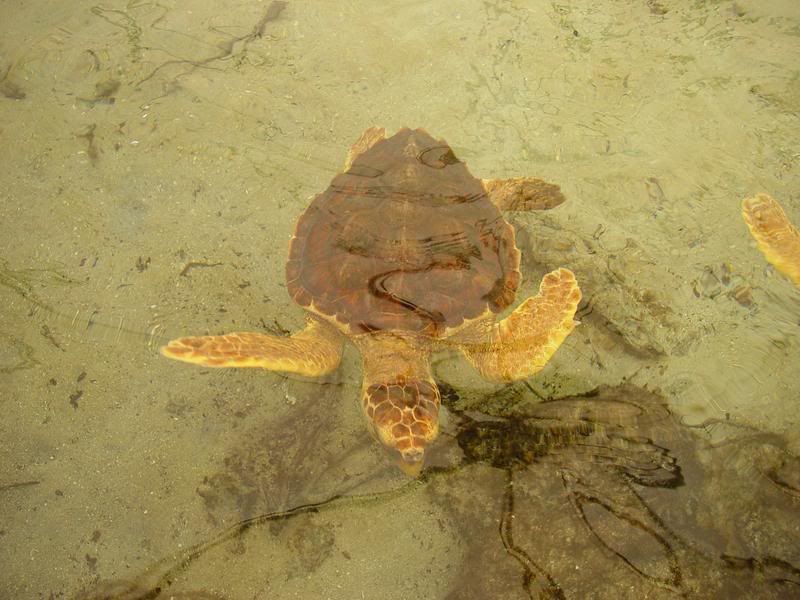
Juvenile loggerhead at Gumbo Limbo Nature Center

If you live near nesting grounds or plan to visit them, please visit S.T.O.P.'s website to learn about sea turtles, their habitat, and what you can do to help protect them. And if you live in the South Florida area, why not think about volunteering your time to help the next generation of sea turtles make it to the sea? All you need is a bucket, a red-light flashlight, and the willingness to go enjoy the ocean breezes and the crashing of the surf for a few hours!