Monday, January 23, 2012

Why vegans should care about wildlife

Bison, hunted nearly to extinction, were brought back from the brink by
careful conservation efforts.

If you’re vegan, chances are high that you care deeply about animals. It may be that your love of domesticated animals - be they dogs, cats, horses, cows, or chickens - is what brought you to a compassionate lifestyle in the first place. It’s also likely that you spend time advocating for companion animals or farmed animals. But what place does wildlife have in your interests? Do you view wildlife protection as a vegan issue?

For those who are vegans for ethical reasons, the answer to this question likely seems obvious. Ethical vegans, who live by the principle that animals are not humankind’s to exploit, generally extend that belief to all animals. They recognize that indirect threats to wildlife, such as environmental pollution or habitat destruction, still constitute human exploitation of these creatures.

But people adopt a vegan diet for many reasons: some who adopt a plant-based way of eating for health or in opposition to food policy or factory farming methods may not consider the protection of wildlife as part of their ideology. For those who are vegan for health or food safety, the issue may not seem so clear. Why should these people care about wildlife?

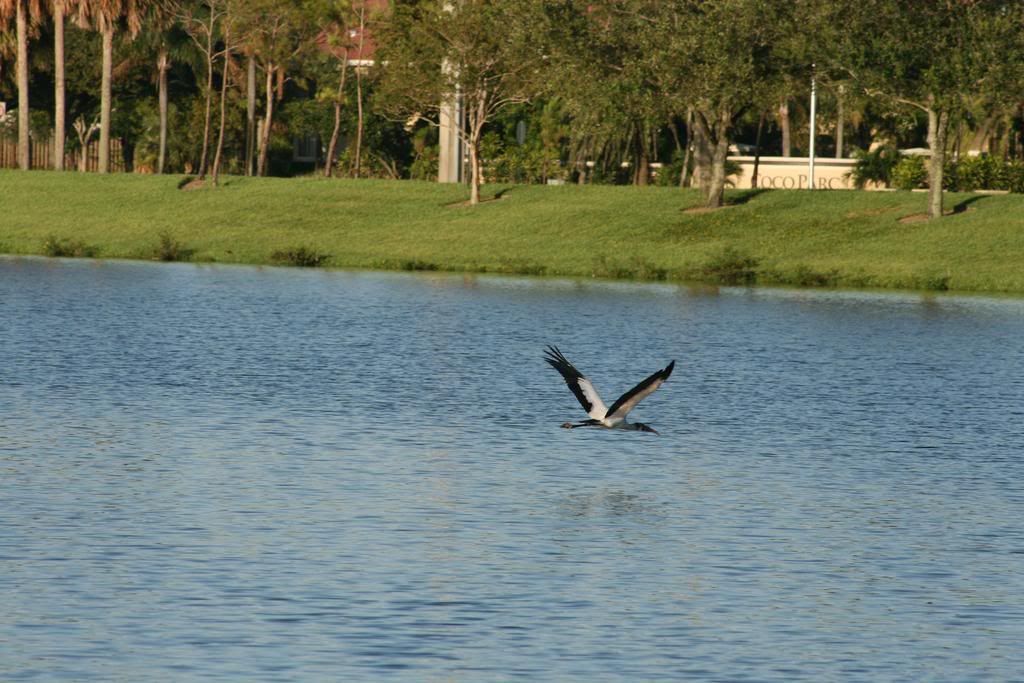
Wood storks are threatened by pollution of their food
supply and destruction of their habitat.


According to a Humane Society of the United States, animal agriculture as an industry is the single largest user of land worldwide. For those whose veganism is based in an opposition to factory farming methods, consider this: animal agriculture has a direct impact on wildlife through the destruction of habitat. Once lands are cleared for livestock production, wild animals that remain in neighboring habitat are killed if they present a potential threat to farmed animals, or the crops grown to feed livestock. Moreover wildlife is killed in the production of livestock feed crops, which account for as much as 50% of the total crop yield globally.
 
For those who adopt a vegan diet for health reasons, consider that the same indirect effects of animal agriculture that affect wildlife - environmental pollution, pesticide usage, contribution to climate change - also affect you. (To learn more about the impact of animal agriculture on climate change, see this HSUS report.) You are part of the ecosystem just as wild animals are. Your water and soil is being polluted, the climate you live in is changing. By fighting to limit the effect of animal agriculture on wildlife and the lands they inhabit, you are limiting the impact on yourself as well.


Every species - human, animal, or plant - is part of the delicate balance of life on this planet. All are interrelated and need to be preserved. While it may seem that fighting the factory farming industry is enough to take on, remember: compassion is a renewable resource. Do your part to preserve and protect all animal life!


(Authored by me, photos by me, originally posted at http://www.thisdishisvegetarian.com/2012/01/why-vegans-should-care-about-wildlife.html)

Friday, January 20, 2012

How to free a sewer gator


As I mentioned previously, there was a gator in our storm sewer at the office. Yes, seriously. Sewer gators may be urban legend elsewhere, but as you can see, in SoFla they're legit. (Though his Wednesday afternoon rescue was big enough news make yesterday's paper - I'm not claiming it's common!)

He'd been in there at least since Friday of the previous week, though some reports had him in there from last Wednesday. When I found out, I knew I needed to call someone, but honestly, I had no idea who. Cue the wonderful folks at the Humane Society's South Florida Wildlife Center.

They advised me to call the Florida Fish & Wildlife Commission, who advised me to call the Statewide Nuisance Alligator Program (SNAP), who told me to call the department of public works, who told me to call SNAP, who then blew me off. Lather, rinse, repeat - I found myself on the phone with the Wildlife Center again.

Thankfully, they know how to navigate the run-around. They gave me some very specific advice: ask for a supervisor, throw my weight around by giving them my full-and-impressive-sounding job title, and demand action. In retrospect, it's funny how such small changes in my approach made all the difference. I never even actually spoke to a supervisor, but just asking to speak to one and sounding intimidating made all the difference.

Within two hours, the department of public works (who had rebuffed me) was out here opening the grate for the trapper, who soon followed. Unfortunately, but that time the alligator had become such a spectacle to the neighbors that he'd spooked and backed up into the pipe. Note to South Floridians: if you see trapped, cornered, or injured wildlife, please stay the heck away! Gawking only stresses the animal.

Over the long weekend, the trapper kept returning to see if the gator was once again within reach. He wasn't. Finally, on Wednesday morning, the gator was again fully under the grate. But now the trapper needed me to get facilities management back out here to open the grate!

No one had told me to get the number from the facilities management guy. So? More phone tag. I called SNAP. They searched their trapping permits and found the contact for Public Works emergency dispatch. Emergency dispatch said all their staff were in the field and told me to call Streets & Highways. The number for S&H was disconnected. Public Works connected me with the county's informational hotline, and they (finally) connected me with the right folks.

The S&H guys thought the whole thing was a hoot. But thankfully, unlike the people in our office park, they listened to me when I asked them to stay back out of the gator's line of sight until the trapper could get here. He arrived and the whole process began.

In the photos, you can see the giant pump truck from the county that fed one end of the pipe, pushing the gator toward the other end where the trapper waited with a rope. He got the rope around the gator, handed it off to the S&H guys to anchor, then reached in and dragged that 7.5 ft gator out by the tail with his bare hands.


I'm sure you're all wondering what happens to the gator now. Well, because the gator exceeded 5 ft. long and residing in a populous area, he was supposed to be "harvested" - government-speak for killed. But this particular trapper (who came recommended by our humane friends as SFWC) instead took him to a preserve in the Everglades where he was released into the wild.

For my fellow Floridians, here are some useful numbers if you're ever in a similar situation:

SNAP: 866-392-4286
Broward County Info Hotline: 954-831-4000

And perhaps the most important number to know for wildlife:

South Florida Wildlife Center: 866-SOS-WILD


Thursday, January 19, 2012

A fat vegan to PCRM: Abandon fat-shaming, ineffective ads!


One of the ads in question. This is fat-shaming, misleading,
and worst of all, ineffective.
Open letter to PCRM sent via:
Vaishali Honawar, vhonawar@pcrm.org
Physician's Committee for Responsible Medicine
Media Contact, Your Abs on Cheese Billboard Campaign

Dear Dr. Barnard and PCRM,

I am a long-time admirer of PCRM, since I was first invited on behalf of my organization to apply for PCRM's Humane Charity Seal of Approval in the early 2000s (a seal we were granted and maintain to this day). I frequently refer individuals to your website, and just last month was privileged to interview a member of your staff for an article I wrote about PCRM that was published on the popular vegan news site This Dish is Veg. So it pains me to tell you how deeply disappointed I am in PCRM's new fat-shaming ad campaign.

There are so many reasons this campaign is disturbing. To begin with, PCRM is an organization I have always relied on for accurate medical information pertaining to a vegan diet. How is it accurate or responsible to suggest that a person cannot be thin while eating cheese, or fat on a vegan diet? We all know that's preposterous. Yes, the standard American diet contributes to obesity, but not all carnists are fat, nor are all vegans thin. This oversimplifies the complex issues surrounding obesity and will therefore be written off as false by thinking individuals, rather than accomplishing the goal of making them consider their dietary choices.

Furthermore, as a fat vegan, I find this campaign personally offensive because of the shaming nature of the imagery. It's hurtful to those of us who already struggle for acceptance within the vegan community because we don't fit the stereotypical image of the skinny vegan. And for fat individuals who may be considering the switch to a vegan lifestyle, it's alienating rather than inviting. 

Finally, PCRM has a long history of taking the high road, relying on scientific fact rather than shocking imagery. When you sink to the level of other organizations that use shock value to stimulate discussion, you lose your credibility and gain opponents rather than friends.

Please, for the sake of the vegan community and your reputation for "Responsible Medicine," abandon this negative, harmful, ineffective campaign tactic.

Sincerely,

Kasey Minnis

Tuesday, January 17, 2012

Confessions of a Reformed Deen Disciple

I am a first generation Southerner, which means I didn't learn Southern cooking from my mom. I learned a bit from my mother-in-law (particularly how to make a perfect biscuit and how to do astonishing things with a green tomato), but most of what I know about Southern cooking I learned from Paula Deen.

I own copies of Lady & Sons and Lady & Sons Too that are tattered from study and use. Back in my pre-vegan days, I went bibbedy with delight when my brother-in-law arranged for me to have dinner at Lady & Sons when I was visiting Savannah. I "improved" upon Paula's hashbrown casserole recipe by adding more cheese.

When I told my husband - a Georgia boy - about Paula Deen hiding her diabetes and continuing to promote her traditional Southern fare for three years, he wasn't in the slightest bit surprised. "I know a woman," he reminded me, "whose entire day was spent in her kitchen, every day of the week. When she finished cooking breakfast, she'd start lunch. That was her world." His point was that food is more than food in many Southern households, and more than just tradition; it's an identity.

Paula Deen, who famously conquered agoraphobia to provide for her children with her cooking, must have a great deal of her identity tied up in the food she cooks. I'm not saying there weren't mercenary reasons for her to hold off on this announcement; her deal with a pharmaceutical company surely indicates there were. I'm just saying that there may be more to it than that.

Working for a nonprofit that supports people diagnosed with a chronic illness, I've seen time and time again that the "stages of grief" apply. Putting myself in Paula's shoes, I'd have been resistant to the idea of changing my diet. I'd have been embarrassed that I'd done this to myself. I'd probably have gone through a period of denial. But then there's that extra little bit of complexity when your cultural identity is tied into your food and you're forced to change the way you eat.

I remember the angst, the absolute suffering I felt upon going vegetarian, when I realized I was going to have to learn to cook my collard greens without a giant hamhock. When I pondered whether my black-eyed peas could possibly taste right without my secret ingredient - bacon. The confusion when I considered making biscuits without sausage gravy... I'm sure it's not easy for anyone to give up the foods they're used to eating, but this wasn't about the deprivation. (I didn't cook them all that often anyway, since I too believed 'moderation' was the best thing for my health when it came to meat and dairy.) It was a question of whether I would be able to express my Southernness without these things.

Ask any Southerner living away from the South what they miss, and you're not likely to hear about the view. They're going to tell you about the cornbread, the sweet tea, the tastes of home. When I go north (because you have to go north to get South from here) to Jacksonville, Atlanta, Savannah, Charleston, any place in the South, the first thing I do is stake out the best Southern restaurant in town and find out what's on the menu. The love of these foods is a primary means of participating in Southern culture. Would I be excluded from the culture without them?

Happily, my commitment to veganism overcame these concerns. Even more happily, I've learned to veganize the foods that help define me as Southern. I still make a mean biscuit and my black-eyed peas still melt in your mouth. Just recently, I thought up a way to veganize Paula's hashbrown casserole that I'm itchin' to try. So I know it can be done.

Do I think that Paula Deen's decision to hide her condition and continue to peddle unhealthy foods for profit was ethical? No way. But human beings are more than just ethics engines, and sometimes right and wrong get muddled by personal hang-ups. My point is rather than being angry at her, I'm spending my energy hoping she'll learn - as I did - that Southern food doesn't have to make you, as Anthony Bourdain called her, "the most dangerous woman in America." Southern food can be healthy too.


“But I could never give up cheese!” - A step-by-step guide to breaking the habit

The one objection I hear most often from people considering making the transition to a vegan diet is “But I could never give up cheese!”

Why cheese? Why not milk, butter, yogurt, sour cream, or ice cream? Because cheese contains concentrated amounts of casomorphins, a natural opiate found in dairy products. Yes, cheese is actually addictive! No wonder the thought of giving it up is hard for cheese-lovers to contemplate.

If you’ve thought you could never give up cheese, take some time and read up on dairy production. (Here is a concise summary of the issues.) Then read the label on the back of a block of cheese, and take note of the saturated fat, cholesterol, and high sodium. (Or try this online nutrition facts tool.  Keep in mind that the 1 oz. serving shown is a single 1-inch cube of cheese!) Consider whether this is really something you want in your diet.

If you arrive at the conclusion that cheese is something you’d like to do without, here is a step-by-step guide to successfully breaking the addiction.

1. Reduce

On cheese-heavy foods, start by using less, giving your palate time to learn to appreciate the other flavors cheese may be drowning out. Order your pizza easy on the cheese, and add on extra veggies. Use just a sprinkle in your bean burrito and add some fresh cilantro to amp up the flavor.

2. Try it without

There are many foods we add cheese to out of habit, and not because they add tremendously to the taste of a dish. Find the foods you can easily appreciate without cheese. Try leaving off the sprinkle of Parmesan on top of your spaghetti marinara, or the slice off your veggie burger. Chances are you won’t miss it much.
Cheese-free pizza? Surprisingly yummy!
Then try eliminating cheese on the foods you can’t imagine without it. A cheeseless pizza? Find a pizzeria with a terrific cheese-free crust and delicious sauce, and smother it in your favorite veggies. Nachos? Add extra salsa, guacamole, or veggies instead. You may just surprise yourself and prefer foods this way.

3. Substitute flavors and textures
As you start to eliminate cheese, you may miss the creamy texture or the umami flavor. Substituting other foods with similar textures or flavors may help. Here are some to try; they may sound a little strange at first, but trust me - you’ll be pleasantly surprised:

Vegan butter - try a little Earth Balance or Smart Balance 100% Organic/Certified Vegan in place of cream cheese on your breakfast bread, or try an ultra-thin layer on a sandwich if it seems dry without that slice of cheese.
Avocado - use slices in place of cheese on subs, wraps, tacos, or burritos.
Artichoke hearts or tapenade - substitute for cheese on a bruschetta or pizza, or in a salad.
Crushed or ground walnuts - use crushed in veggie dishes or ground in pasta in place of grated Parmesan.
Hummus - if you’re missing cheese and crackers as a snack, try hummus or bean dip as an alternative. These also make great sandwich spreads.

4. Try cheese alternatives

You probably won’t appreciate non-dairy cheeses or cheese alternatives until you’ve been off cheese for a week or two. Then it will take a little trial and error to find your favorites.

Start with Daiya - most vegans agree it’s a favorite. Made from tapioca, Daiya melts well and has great flavor. Just start with a little less than you would have normally used with dairy cheeses.

Most grocery or health food stores carry rice cheeses or soy cheeses. (Make sure your soy cheese is vegan; some contain casein, a milk protein.) Some also carry nut cheeses, which have great umami flavor and are a terrific alternative for those without nut allergies.

5. Make your own non-dairy cheeses
Have you ever thought about making cheese? Making non-dairy cheeses at home is not as hard as you might think. For example, this vegan Parmesan takes just a moment to prepare. VegNews’ macaroni and cheese recipe takes no longer than any other homemade mac and cheese. (That cheese sauce also works great for casseroles.) Or if you want to get fancy, buy some cheese cloth and make an almond feta or baked cashew cheese.

After a while, you’ll begin to see that the dependency on cheese is less about flavor and more about habit and addiction. Don’t let that be an obstacle to a healthier, more compassionate diet!

Monday, January 16, 2012

Vegans & Wildlife: A Floridian Perspective


I’m currently working on an article for This Dish is Veg on why vegans should care about wildlife. When I first realized that not all vegans are wildlife advocates, I was confused. How is it that some people distinguish between farm animals, companion animals, and wild animals? How do they not consider wildlife with the same interest and compassion?

But over the last few years of traveling - visiting parks and natural areas in Georgia, South Carolina, Maryland, Pennsylvania, Wisconsin, Illinois, Oregon, and Washington  - I’ve come to realize that being born and raised in South Florida gives me a different perspective on and relationship to wildlife than other people have.

A Little Context

The Miami-Fort Lauderdale metropolitan area is the eighth largest mass of human life in the country, according to the most recent U.S. Census Data. But it sits wedged between the ocean and the Everglades, in one of the most biologically diverse environments in the country. The only major metropolitan area in the U.S. with a tropical climate, it teems with life in every available inch of green space, and that life spills over onto the concrete and asphalt. 
An endangered woodstork hanging out at neighboring suburb's pond.

Fort Lauderdale, my hometown, is nicknamed “The Venice of America” because of its intricate system of canals. Though I live a city block in either direction from a canal, I frequently see flocks of ibis picking bugs out of neighbors’ neatly-manicured lawns when I leave for work in the morning, and double-breasted cormorants sitting on streetlights when I return home at night. In my neighborhood, where the human population density is 8,865 people per square mile, it’s not surprising to see Quaker parrots, egrets, iguanas, or snakes visiting your backyard. Though my house is five miles inland, I often see seagulls circling around the local restaurants.

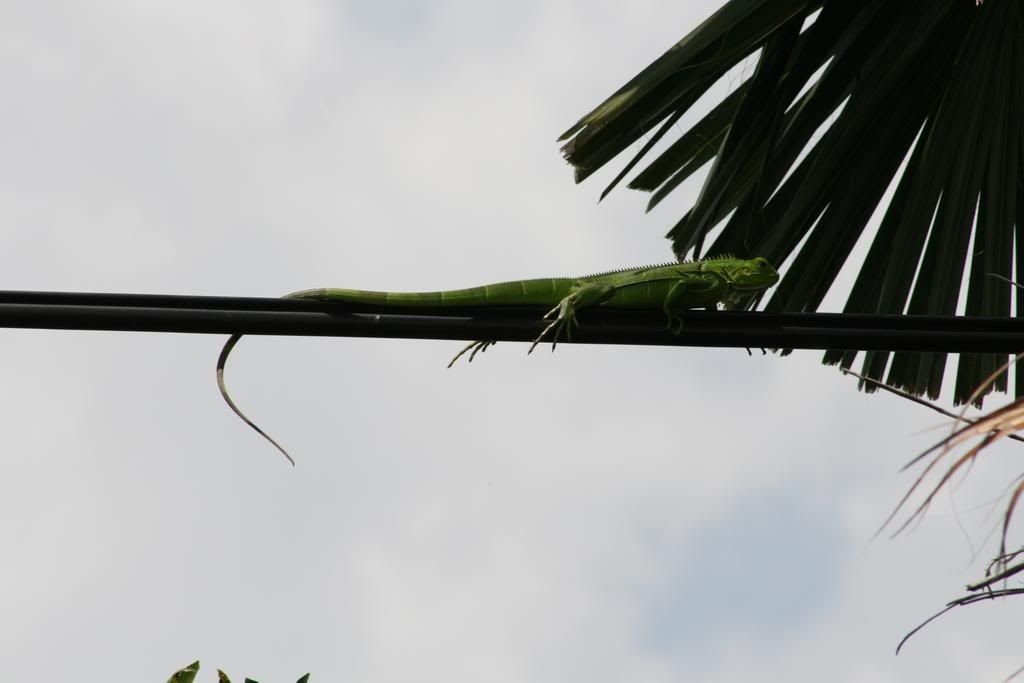
Green iguana on the telephone wire in my backyard.
And nevermind the birds and reptiles, the place is crawling with creepy-crawlies. On one memorable backyard photo safari, I captured four types of butterfly, three varieties of ladybug, two types of bees, plus ants, beetles, bottle flies, and most memorably, an assassin bug, all in one morning. Lizards, frogs, and spiders are also commonplace outdoors, and not at all surprising indoors.
Gator in the storm drain of my office park last week.
A short journey to any neighborhood park with a body of water will show you dozens of kinds of wading and songbirds, as well as turtles, ducks, and the occasional gator. An hour’s drive inland will put you in the big swamp, but small pockets of wetlands dot the urban landscape. In fifteen minutes, I can choose between kayaking a mangrove swamp populated with osprey, herons, and tree-climbing crabs, or a Cypress swamp, where bobcats, armadillo, and raccoons share space with river otters and songbirds. Or, of course, the Atlantic Ocean, with pelicans, sandpipers, and gulls snapping fish out of the shallows, coral, sponge, and man-o-war washing up on the shore, and the occasional shark or barracuda swimming near the pier.

In comparison, most other places I visit seem tame, sometimes almost lifeless. It is strange to me to walk through a neighborhood or park and not to hear the constant chirp and scrape of insects, the crackle of branches as lizards flee from my footsteps into the brush, the ever-present song of birds. It’s odd to stand near water and not see long-legged birds wading and sharp-eyed birds circling overhead.

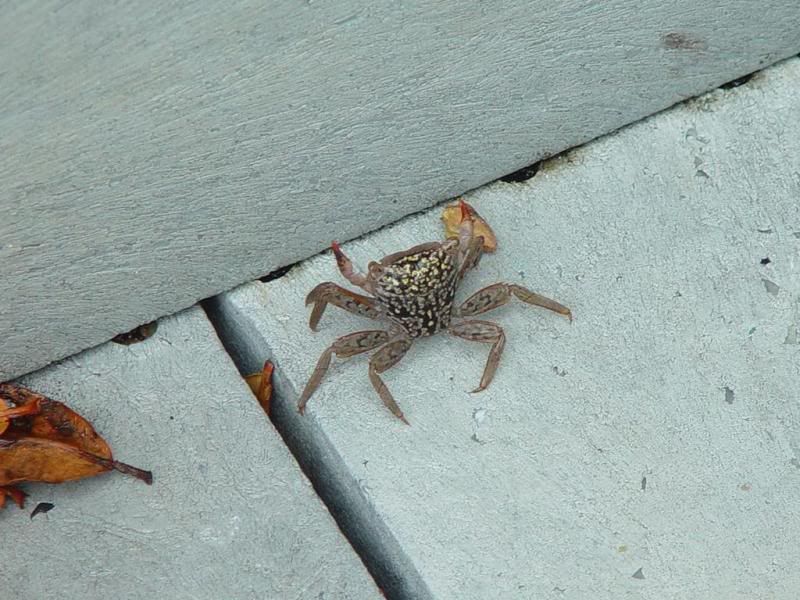
A mangrove tree crab scuttles along the boardwalk.
A friend pointed out that urban wildlife exists in most cities, and that’s true. I’m just explaining the scope of our interaction here. There’s a reason that the South Florida Wildlife Center is the busiest wildlife hospital in the country. Wild animals are omnipresent. Everywhere, every day of the year, you can look up, down, or sideways and find a living creature. And humans are stomping around in their space.

So conservation is drilled into Florida natives. Our beaches have reduced lighting zones to facilitate sea turtle nesting. Our waterways are dotted with ‘no wake’ zones to protect wintering manatees. Roads that traverse the swamp have different daytime and nighttime speed limits for the safety of the nocturnal Florida panther. According to the Florida Natural Areas Inventory, we have over nine million acres of conservation lands, not including submerged areas such as lakes, bays,  and aquatic preserves. Between national parks, national forests, national wildlife refuges, state parks, city parks, water management district parks, privately or nonprofit-owned sanctuaries, preserves, and rescues, etc., there are managed wildlife areas everywhere you turn.

What About Farm Animals?

Horses on a county trail that runs right behind a suburban housing complex.
Even if you’ve never been to Florida, this description is probably not altogether surprising. The image people have of Florida generally revolves around Flipper and alligators, so the idea that it’s a tropical haven for wildlife is consistent. But did you know that animal agriculture is one of the largest industries in Florida? The very name we natives are called - Crackers - is mythologized as the sound of a cattle driver’s whip. Until very recently, there were still horse paths about three miles from my very urban home. About three miles in the other direction was a large dairy.

Of course, in recent years, it has been less and less common to see herds of cows in pastures as you drive South Florida’s roads. As any vegan knows, cows no longer reside in pastures - they reside in factories. Horses are still fairly common on the streets in a few areas of my county, and chickens are quite common on the streets in some neighborhoods. Lately, there are two chickens hanging around on the grass outside my gym; I often see them through the window when I’m swimming laps.

So from an early age, companion animals, farm animals, and wild animals were present in my life, and they continue to be so. I’ve never made any distinction in my love of animals, and I certainly make no distinction in my interest in preserving their lives and reducing their suffering.

A Wildlife Awakening
Insects clustered on a branch in the hours after
Hurricane Ernesto swept through town.

In fact, a love of wild animals played a significant part in my return to a compassionate lifestyle. I became a vegetarian the first time when I made the connection between the chicken in the petting zoo and the chicken on my plate. More recently, when I returned to a vegetarian diet before becoming vegan, it was the realization that Japan’s tradition of eating wild and beautiful cetaceans was no different than my eating domesticated animals. (This is why my husband blames Whale Wars.)

So, to me, it’s very difficult to understand why anyone wouldn’t see wildlife conservation as a vegan issue. When I first returned to a compassionate diet, I wrote that I was doing so because I didn’t want any living creature to have to die on my behalf. Isn’t that the essence of veganism? To seek to end the needless death of animals? And aren’t the deaths of wild animals as a result of development or pollution just as needless?

I’ll explore these points further in the upcoming article. I’d love to hear your thoughts on the issue. What is interaction with wildlife like in your neck of the woods? Do you feel the wildlife conservation is a vegan issue? Where do you stand on conservation, and how does your exposure to wildlife inform your view?

The legacy of Dr. Martin Luther King, Jr. for animal advocates


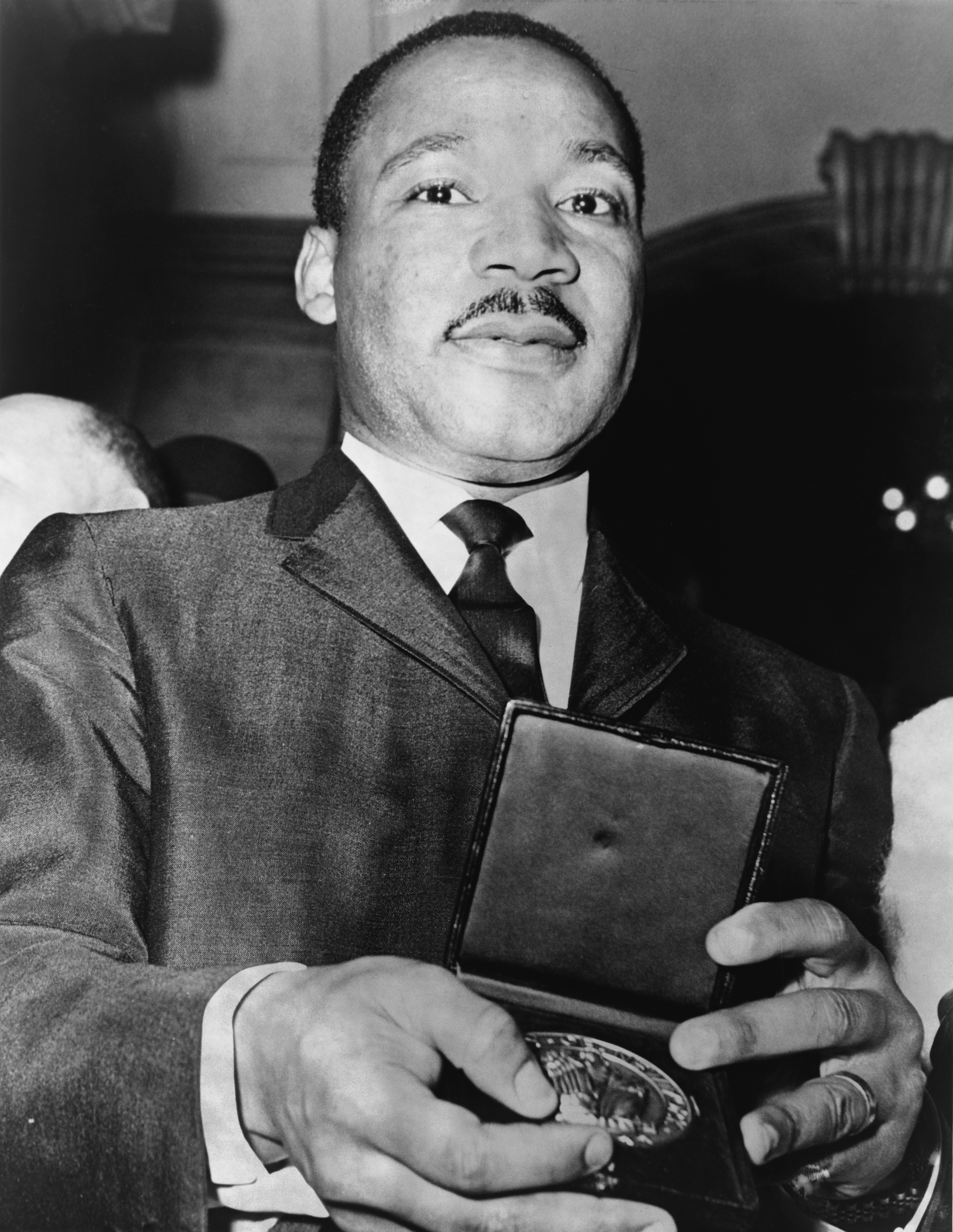
By Phil Stanziola, NYWT&S staff photographer [Public domain], via Wikimedia Commons

Today, the country honors the memory of a great leader in the fight for civil rights in America, Dr. Martin Luther King, Jr. While King’s focus was on human rights rather than animal rights, his passionate belief in non-violence and the value of all living beings has led many to believe that veganism is the natural extension of the philosophy he espoused. Those who believe this included his late wife, activist Coretta Scott King, who was vegan for a decade prior to her death, as well as his son, Dexter Scott King, who has been vegan and an animal advocate for over 20 years.

Here are some inspiring words from Dr. King for animal advocates:

“The hope of a secure and livable world lies with disciplined nonconformists who are dedicated to justice, peace and brotherhood.”

“The question is not whether we will be extremists, but what kind of extremists we will be... The nation and the world are in dire need of creative extremists.”

“He who passively accepts evil is as much involved in it as he who helps to perpetrate it. He who accepts evil without protesting against it is really cooperating with it.”

“Never succumb to the temptation of bitterness.”

“All I'm saying is simply this, that all life is interrelated, that somehow we're caught in an inescapable network of mutuality tied in a single garment of destiny. Whatever affects one directly affects all indirectly.”

“At the center of non-violence stands the principle of love.”

Wednesday, January 11, 2012

Darling NWR Bailey Tract

We went to the Bailey Tract of Ding Darling NWR to look for alligators and turtles. But the day was too cold and we found none. However, there were still interesting things to see, including some spectacular insect life.

Sunday, January 8, 2012

TDIV: Is it possible to be truly vegan in the modern world?


The following post, authored by me, was originally published on This Dish is Veg on 12/22/11.

Is it possible to be truly vegan in the modern world? There are many reasons to raise this question. Never mind the societal pressures vegans face, or the challenges in finding healthy vegan food options; there are other ways that we may affect the lives of animals without even knowing it.

Animal products are in many items one might not expect: from vaccines and vitamins, to beer or blankets. It can be difficult, sometimes seemingly impossible, to find out the ingredients of every item we use or consume. More disturbingly, in a recent Food Network survey, 15% of restaurant chefs admitted to using non-vegetarian ingredients in supposedly vegetarian dishes. The possibility that we may unknowingly ingest or use animal products definitely exists.

But the most alarming argument against the ability to maintain a vegan lifestyle today is in regards to the animals killed in the growing of grain, rice and vegetables.

In the process of clearing land for crops, small animals such as mice, moles, and rabbits can be killed. In the preparation of rice paddies, frogs may be killed. No accurate numbers are available as to how many animals this may affect, but one animal ethics professor, Steven Davis of Oregon State University, suggests the numbers are in the millions each year.

So if animals are killed in the production of the food vegans consume, are we in fact truly vegan?

To answer this question, we must begin by defining the word “vegan.” A commonly accepted definition, originated by The Vegan Society in 1978, is “a philosophy and way of living which seeks to exclude — as far as is possible and practical — all forms of exploitation of, and cruelty to, animals for food, clothing or any other purpose; and by extension, promotes the development and use of animal-free alternatives for the benefit of humans, animals and the environment. In dietary terms it denotes the practice of dispensing with all products derived wholly or partly from animals.”

The very definition of the term acknowledges that it is not always “possible and practical” to eliminate all animal death from human existence. Any gardener can tell you that even when preparing the soil with simple hand tools, it’s quite possible to inadvertently kill insects, worms, snakes or other garden-dwellers. Should we then never plant food but live only on what we can gather? That would be neither possible nor practical.

Back to the definition: are we exploiting or demonstrating cruelty towards the unseen snake that falls foul of our shovel during planting? Or is the loss of its life a sad but unavoidable effect of human existence? Can we say the same about a cow that is repeatedly impregnated, only to have its offspring torn away and slaughtered for veal, so that we can keep that cow in a perpetual state of lactation inside a cramped warehouse for the remainder of its "natural" life?

Other animal ethicists have argued Davis’s conclusion that a diet including meat causes less animal death than a vegan diet, citing flaws in his methodology, the issue of quality of life versus quantity of deaths, the incidental nature as opposed to intentional killing and other points. More to the point, Davis’s argument for continuing to eat meat is predicated on the hypothetical idea that the animals consumed be grass-fed, not grain-fed. This doesn't reflect reality. Currently, 99% of all animals raised for meat are grain-fed in factory farms. In fact, the majority of grain, corn, and soy grown worldwide is used to feed factory farmed livestock. Since it takes 16 pounds of grain to produce a single pound of meat, going vegan actually reduces the number of animals killed in the grain production for an individual’s diet significantly!

However, even if this were not the case, Davis’s argument oversimplifies veganism -- as though it were simply a matter of balancing numbers on a scale. Instead, it is a compassionate lifestyle that seeks to reduce animal suffering. While we cannot place more value on one animal life over another, most would agree that the momentary suffering of an animal suddenly struck down in the field is less cruel an entire life spent in unnatural suffering at the hands of man.

Veganism is not focused on animal death; it’s focused on life and the quality thereof -- animal life, human life, and the life of our planet. A wild animal in the field, even one who dies, has experienced a natural life. A person who follows a vegan diet, to the extent possible and practical, can expect better quality of life thanks to the many health benefits. And the life of our planet is prolonged by each and every person who adopts a plant-based diet. So a vegan who accidentally ingests or uses animal products, or who eats plant foods that may have caused inadvertent animal death, is still "seeking to exclude, as far as possible and practical," any exploitation of or cruelty to animals.

Is it possible to live in the modern world and never be a party to animal death or suffering? Probably not. Is it possible to live a vegan life? Absolutely.